

Understanding the Two Types of EV Charging
Electric vehicle adoption is accelerating across Singapore, and with it comes an operational question every fleet operator must answer: Should your fleet rely on AC charging, DC charging, or a combination of both?
While both methods deliver electricity to the vehicle battery, the way they do so has significant implications for charging speed, infrastructure costs, and fleet uptime.

Alternating Current (AC) charging works by delivering electricity to the vehicle, where the car’s onboard charger converts the AC into direct current before it enters the battery. Because the onboard converter is relatively small, charging speeds are slower. Typical AC chargers operate between 7kW and 22kW, meaning a full charge may take 4–10 hours depending on battery capacity.
Direct Current (DC) charging, on the other hand, performs the conversion within the charging station itself. The charger sends DC power directly to the battery, bypassing the vehicle’s onboard converter. This allows for significantly faster charging speeds, often ranging from 30kW up to 350kW, enabling vehicles to recharge in 30 to 120 minutes depending on power level and vehicle capability.
Understanding these two approaches is an operational decision that shapes fleet productivity.
Matching Charging Strategy to Real-World Fleet Operations
Choosing between AC and DC Charging begins with understanding how vehicles behave in real operations.
AC charging is typically best suited for long-stay parking scenarios, such as staff parking, overnight depot charging, or office buildings where vehicles remain parked for several hours. Because AC chargers have lower electrical load requirements and lower installation costs, they are easier to integrate into existing electrical systems.

For businesses operating delivery fleets or service vehicles, the operational requirement is often different. Vehicles may only stop briefly between routes, requiring quick turnaround times. In these situations, DC fast charging becomes critical.
DC chargers support rapid top-ups during short stops, enabling vehicles to return to the road quickly. However, they require higher electrical capacity, more complex infrastructure, and higher installation costs compared with AC chargers.
In practice, many commercial operators deploy a hybrid charging strategy: AC chargers for overnight charging and DC chargers for daytime operational top-ups.
Why Charging Compatibility Matters for Fleet Reliability
Beyond charging speed, connector compatibility plays a crucial role in fleet uptime.
Across Singapore and Europe-aligned charging infrastructure, the CCS2 (Combined Charging System Type 2) connector has become the standard for both AC and DC charging. Vehicles compatible with CCS2 can access a wide range of public and private chargers across the island.
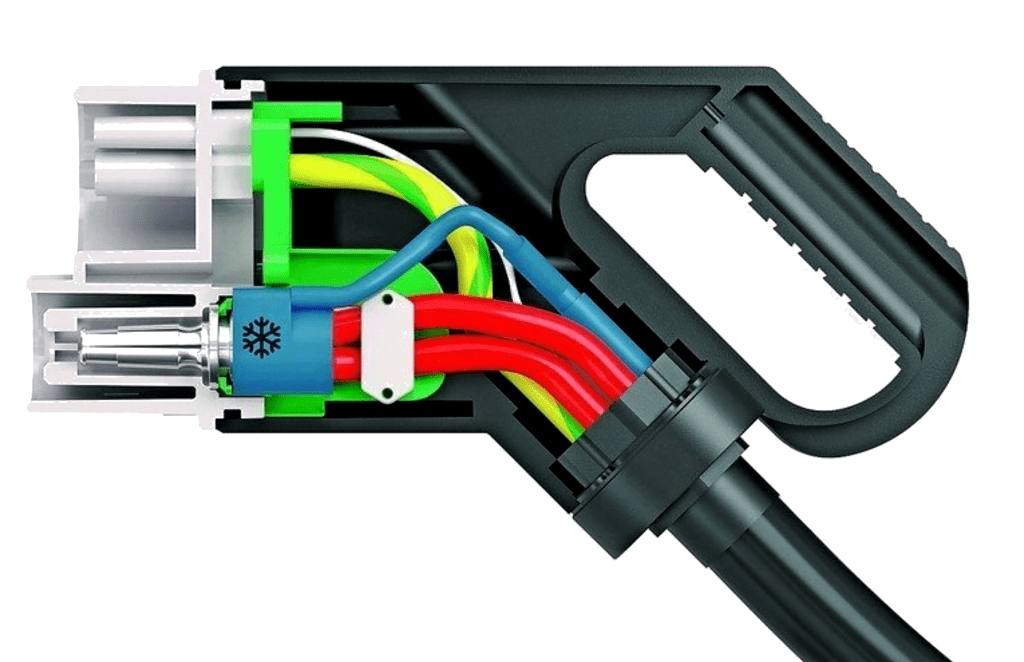
This is particularly important for logistics operators who rely on multiple charging environments, including depot charging, workplace charging, and public charging networks.
Compatibility ensures that vehicles can charge wherever power is available, reducing operational risk and ensuring fleets remain productive.
How Green Volt EVs Support Flexible Charging Strategies
At Green Volt, we design electric mobility solutions around real-world business operations.
Our H5C electric van, built for urban logistics and last-mile delivery, combines a 10 m³ cargo hold with over 1-ton payload capacity, making it ideal for companies moving goods daily. It is powered by a 70.47 kWh CATL LFP battery, known for durability, fast charging capability, and long service life.
For service teams and multi-purpose transport needs, the H5F electric van provides a flexible 10-seater configuration while maintaining the same 70.47 kWh CATL LFP battery platform.

Both vehicles support CCS2 connectors for AC and DC charging, allowing businesses to adopt either slow overnight charging or rapid daytime top-ups depending on operational needs.
Combined with their electric drivetrain (fewer moving parts) and smart control system for diagnostics and maintenance, these vehicles are designed to reduce downtime and simplify fleet management.

